Short answer
Trap BPM is 130 to 150 BPM in most records, and 140 BPM is the standard starting point. The catch is that trap feels half as fast as the number says, about 65 to 75 BPM, because the clap lands only once per bar, on beat 3. Tap along on the Tap BPM tool at Tap BPM tool and you will get the fast number, 140. Your head nods to the slow one, 70.
What BPM is trap?
The trap BPM range is a band with lanes inside it. The lanes below are the conventions producers actually use, counted the way a DAW counts them. If you are lost, start at 140.
| Lane | DAW tempo | How it feels (half-time) | Best for |
|---|---|---|---|
| Slower, melodic trap | 130 to 140 BPM | 65 to 70 BPM | Sung hooks, long vocal lines, emotional beats |
| Standard Atlanta-style trap | 140 to 150 BPM | 70 to 75 BPM | Rap verses, triplet flows, most commercial records |
| Faster, aggressive trap | 150 to 160 BPM | 75 to 80 BPM | High-energy verses, rage and hypertrap |
| EDM or festival trap | 140 to 150 BPM | 70 to 75 BPM | Big drops, the same half-time feel with louder sound design |
| Drill (trap's close relative) | 138 to 145 BPM | 69 to 73 BPM | Sliding 808s, different drum placement, same tempo zone |
Below 130 BPM the groove starts to drag, because with one clap per bar the felt tempo drops under 65 BPM. Above 160 BPM the hi-hats blur together and the beat crosses into drill or electronic territory.
Why 140 BPM feels like 70
Two clocks run at once in a trap beat. The hi-hats run at the full 140 BPM, while the clap runs at half speed: one hit per bar, on beat 3. Your head follows the clap, so the song feels like 70 BPM. That split is the sound of trap: slow and heavy on top, fast and restless underneath. Work at 140, not 70: rolls and slides are easier to draw on a fine grid, and sample packs label trap at the higher figure. Our half-time guide explains the same illusion in other genres: Half-Time vs Double-Time BPM guide
Trap BPM timing: the table
One beat lasts 60,000 divided by BPM in milliseconds, and one bar of 4/4 lasts four beats. Read your delay and reverb times off this table, and never time them to the felt 70 BPM.
| Tempo | One beat | One bar of 4/4 | Feels like | 16th note | Dotted eighth |
|---|---|---|---|---|---|
| 130 BPM | 461.5 ms | 1.85 seconds | 65 BPM | 115.4 ms | 346.2 ms |
| 135 BPM | 444.4 ms | 1.78 seconds | 67.5 BPM | 111.1 ms | 333.3 ms |
| 140 BPM | 428.6 ms | 1.71 seconds | 70 BPM | 107.1 ms | 321.4 ms |
| 145 BPM | 413.8 ms | 1.66 seconds | 72.5 BPM | 103.4 ms | 310.3 ms |
| 150 BPM | 400.0 ms | 1.60 seconds | 75 BPM | 100.0 ms | 300.0 ms |
At 140 BPM a dotted-eighth delay is 321.4 ms, a 16th-note delay is 107.1 ms and a 4-bar loop lasts 6.86 seconds. For other tempos, use our BPM to milliseconds calculator at BPM to milliseconds calculator.
Worked example: one bar of trap at 140 BPM
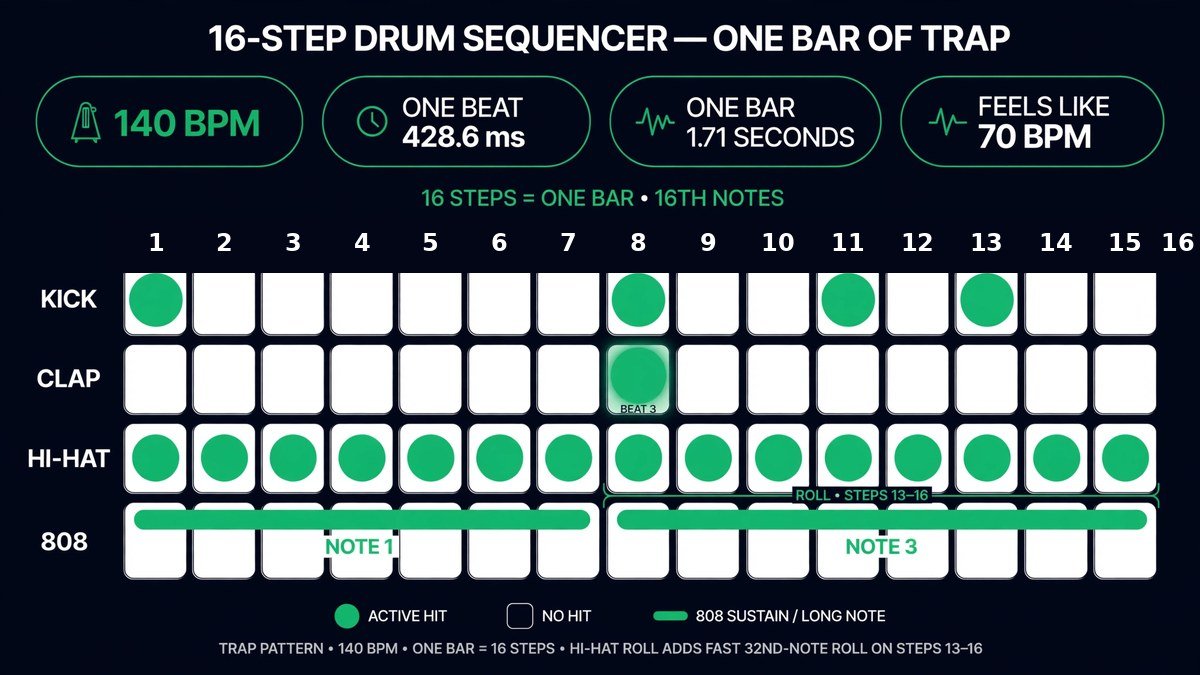
Set 140 BPM in 4/4 and work on a 16-step grid, one step per 16th note.
- Put the kick on steps 1, 8, 11 and 13: step 1 is the downbeat, the rest push against the clap.
- Put one clap on step 9, beat 3, layered with a snare. This single hit is the half-time feel.
- Put a closed hi-hat on every step, then turn steps 13 to 16 into a 32nd-note roll into the next bar.
- Write the 808 as two long notes starting on steps 1 and 9, tuned to the key of your melody.
- Check it: one bar is 1.71 seconds, so four bars last 6.86 seconds. If the loop drifts, the tempo is wrong.
The 808: tuned bass that carries the song
The 808 is the long, tuned bass drum from the Roland TR-808. In trap it is both the kick and the bassline, and because it is pitched it is usually the first thing that clashes when the melody is in the wrong key. Tune the 808 to the melody first.
| Key | 808 root note | Frequency | Semitones from C1 |
|---|---|---|---|
| C minor | C1 | 32.7 Hz | 0 |
| D minor | D1 | 36.7 Hz | +2 |
| E minor | E1 | 41.2 Hz | +4 |
| F minor | F1 | 43.7 Hz | +5 |
| G minor | G1 | 49.0 Hz | +7 |
| A minor | A1 | 55.0 Hz | +9 |
Most trap sits in minor keys; F, G and A minor are the most common because they put the 808 root deep but still audible. Set the sampler to mono with legato on and overlap notes so they slide. A glide of 60 to 150 ms sounds natural; longer slides suit drill. Keep the kick short, let the 808 carry everything below 80 Hz, and sidechain it to the kick if the two blur. Check the low end on a phone speaker: if the 808 disappears, add saturation.
Hi-hat rolls: the fast layer
Hats are where trap shows off. Start with closed hats on every 16th note, then vary the velocity: downbeats at 100 to 127, offbeats at 60 to 80, inner 16ths at 40 to 60. Rolls are short bursts of 32nd notes, eight hits per beat at 140 BPM with 53.6 ms between hits, placed at the end of a bar or just before the clap. Program the velocity low to high inside the roll, for example 40, 60, 80, 100, 127, so it accelerates into the next hit.
Pick your trap BPM by job
Do not agonise over 142 versus 144. Nobody listening can hear two BPM. Pick the lane that fits the job, then spend your time on the hats and the 808.
| Job | Start at | Why |
|---|---|---|
| Melodic beat with sung vocals | 132 BPM | The felt 66 BPM leaves long gaps for vocal lines and the 808 melody |
| Standard rap beat | 140 BPM | The middle of the convention, triplet flows sit naturally, most reference tracks live here |
| Dark, moody street record | 138 BPM | Slightly under the standard, heavier pocket, still inside the lane |
| Aggressive, high-energy beat | 155 BPM | Hats get urgent, the felt 77.5 BPM still grooves, energy rises without changing volume |
| Festival or EDM trap drop | 150 BPM | The drop hits hard at the top of the standard lane with the same half-time bounce |
The verse-counting trap
Rappers count bars at the felt tempo, where the clap falls on 2 and 4, so a 16-bar verse is 32 bars in a 140 BPM session. One session bar lasts 1.71 seconds, so a 16-bar verse lasts 54.9 seconds and a full 128-bar song lasts 3 minutes 39 seconds. Stay at 140 and count in session bars: intro 8, hook 16, verse 32, hook 16, verse 32, hook 16, outro 8.
How to find the BPM of a trap song
Detectors often hand you 70-something instead of 140-something for trap, because they lock onto the clap. Tap the clap on the Tap BPM tool at Tap BPM tool for 15 seconds, then multiply your count by 4: 18 claps is 72 BPM, the felt tempo. Double it: 144 BPM is the trap BPM a producer would set. Check it by counting hi-hat hits for 15 seconds: at 144 BPM you should count about 36. The rule: a trap reading under 100, double it; over 170 on a slow, heavy track, halve it.
Common mistakes
- Setting the DAW to 70 BPM. The grid gets too coarse for rolls, and sample packs will not line up.
- Counting hi-hats as beats. Count the clap, not the hats.
- Timing delay to the felt tempo: 321.4 ms at 140 BPM becomes 642.9 ms at 70 BPM.
- Putting the snare on beats 2 and 4. That is a hip hop backbeat; trap puts one clap on beat 3.
- Leaving the 808 out of key. A semitone off makes the low end sound sour.
- Filling every step. Trap is minimal: kick, clap, hats, 808, one melody. The space between the hits is the groove.
Frequently asked questions
What is a good BPM for trap?
140 BPM is the best starting point: a good trap BPM sits in the middle of the 130 to 150 BPM range and fits triplet flows, fast hats and long 808 notes. Go to 130 to 140 for melodic beats, 150 to 160 for aggressive ones.
How fast is trap music?
Trap is produced at 130 to 160 BPM but feels like 65 to 80 BPM, because of the half-time clap on beat 3.
Is trap 70 or 140 BPM?
Both. The clap lands once per bar at 140 BPM, so the groove feels like 70 BPM. Producers set the DAW to 140 BPM so the hi-hat rolls and 808 slides fit the grid.
Why does my BPM detector say 72 for a trap song?
It locked onto the clap instead of the hi-hats. Double the number to get the figure most producers use: 72 doubled is 144 BPM.