Short answer
BPM vs tempo vs time signature comes down to three different questions. Tempo asks how fast the music feels. BPM answers that question with a number. Time signature asks how the beats are grouped into bars. The Tap BPM tool at TappingBPM Home gives you the BPM, but the BPM alone never tells you the time signature. A waltz in 3/4 and a pop song in 4/4 can both run at 120 BPM, yet they feel different.
What is tempo?
Tempo is the speed of a piece of music as a musical idea. Before numbers existed, tempo was an Italian word: Adagio meant slow and stately, Andante meant walking pace, Allegro meant fast and bright, Presto meant very fast. Tempo can also change inside one piece: ritardando means gradually slower, accelerando means gradually faster. One BPM number cannot capture that.
What is BPM?
BPM stands for beats per minute, the number that measures tempo. At 60 BPM there is one beat per second; at 120 BPM there are two. Beat length equals 60,000 divided by BPM, so at 128 BPM each beat lasts 468.8 ms. That is the bpm vs tempo distinction: tempo is the idea, BPM is the measurement. In a DAW the tempo field is just a BPM number.
What is a time signature?
A time signature is the pair of stacked numbers at the start of a piece, and it tells you how beats are grouped into bars. The top number says how many beats are in each bar. The bottom number says which note value gets one beat. In 4/4 there are four quarter-note beats per bar, in 3/4 there are three, the waltz feel, and in 2/2, called cut time, the half note gets the beat. In 6/8 and 12/8 the felt beat is the dotted quarter. A time signature describes grouping, not speed: where the accents fall and how to count, never how fast the metronome ticks.
| Term | What it answers | Example | Expressed as |
|---|---|---|---|
| Tempo | How fast does it feel, and with what character? | Allegro, fast and bright | Italian word or metronome mark |
| BPM | How fast, exactly? | 128 beats per minute | A number |
| Time signature | How are the beats grouped? | 4/4, four beats per bar | Two stacked numbers |
How long is one bar? Worked maths
BPM and time signature meet in one formula: seconds per bar equals beats per bar multiplied by 60, divided by BPM. The beat spacing stays the same at a given BPM. Only the beat count changes, so the bar gets longer or shorter.
| BPM | Beat length | One bar of 4/4 | One bar of 3/4 |
|---|---|---|---|
| 90 BPM | 666.7 ms | 2.67 seconds | 2.00 seconds |
| 100 BPM | 600.0 ms | 2.40 seconds | 1.80 seconds |
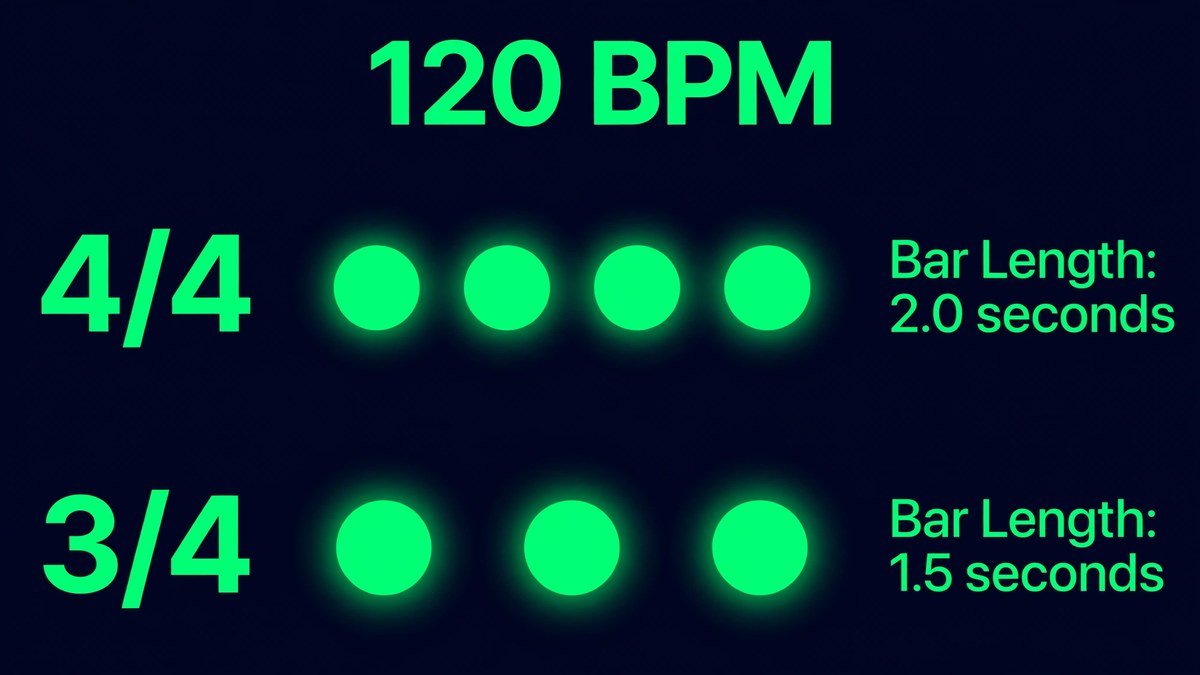
| 120 BPM | 500.0 ms | 2.00 seconds | 1.50 seconds |
| 128 BPM | 468.8 ms | 1.88 seconds | 1.41 seconds |
| 140 BPM | 428.6 ms | 1.71 seconds | 1.29 seconds |
| 174 BPM | 344.8 ms | 1.38 seconds | 1.03 seconds |
An 8-bar phrase of 4/4 at 128 BPM lasts exactly 15 seconds; the same 8 bars in 3/4 last 11.25 seconds. For the beat-level version, use our BPM to milliseconds calculator at BPM To MS Calculator or the Music Tempo Chart at Music Tempo Chart.
Worked example: one song, all three terms, in 5 steps
Take a house track you like.
- Find the BPM. Tap along on the Tap BPM tool at TappingBPM Home for 16 beats. Say it settles on 128 BPM.
- Name the tempo. 128 BPM is Allegro, fast and bright.
- Count the time signature. Listen for the downbeat: ONE two three four. Four beats per bar means 4/4.
- Work out the bar length. One bar lasts 4 times 60 divided by 128, which is 1.875 seconds.
- Check it. An 8-bar phrase should last 15 seconds. If the next phrase starts 15 seconds after a downbeat, all three are confirmed: Allegro, 128 BPM, 4/4.
Try it in 3 minutes: the metronome drill
Set our online metronome at Online Metronome to 100 BPM in 4/4 and count ONE two three four. Now switch to 3/4 without touching the tempo: the ticking speed never changes, only the accent pattern does. Try 6/8 next: the clicks group in threes.
Why the same BPM feels different
Play a 4/4 groove and a 6/8 groove at the same BPM and the 6/8 one often feels faster. The metronome has not changed. The accent pattern has: in 4/4 the strong accent lands every four beats, in 6/8 accents fall in rolling groups of three. At 120 BPM, 4/4 gives a downbeat every 2 seconds and 3/4 every 1.5 seconds.
Odd meters: 5/4, 7/4, 9/8 and 12/8
Watch the 12/8 trap: the bar lasts 2.0 seconds at a dotted-quarter tempo of 120, the same as 4/4 at 120, but the subdivision rolls in threes, so counting eighth notes as beats doubles your reading. Our half-time guide explains this in full: Half Time vs Double Time BPM
| Time signature | Beats per bar | Feel and example | One bar at 120 BPM |
|---|---|---|---|
| 5/4 | 5 quarter notes | Take Five by Dave Brubeck, counted 3 plus 2 | 2.50 seconds |
| 7/4 | 7 quarter notes | Money by Pink Floyd, counted 4 plus 3 | 3.50 seconds |
| 9/8 | 9 eighth notes | Counted in three groups of three | 2.25 seconds |
| 12/8 | 4 dotted-quarter beats | Blues shuffle, rolling triplet feel | 2.00 seconds |
Italian tempo markings and their BPM ranges
The Italian words map to rough ranges, not exact numbers, and they vary by source and era. That vagueness is why the metronome was invented. For modern genre bands, see our standard BPM guide at Standard BPM For Music Genres.
| Marking | Meaning | Approx. BPM |
|---|---|---|
| Largo | Slow and broad | 40 to 66 |
| Adagio | Slow and stately | 44 to 66 |
| Andante | Walking pace | 56 to 108 |
| Moderato | Moderate speed | 108 to 120 |
| Allegro | Fast and bright | 120 to 156 |
| Vivace | Lively and fast | 156 to 176 |
| Presto | Very fast | 168 to 200 |
| Prestissimo | As fast as possible | 200 and above |
Which number do you trust when readings disagree?
The DAW says 70, your ears say 140. Use this 3-check rule. First, tap it yourself on the Tap BPM tool for 16 bars. Second, try the halve or double test. If the reading is exactly half or double what you expected, the detector locked onto the wrong layer: trap and dubstep write on a fast grid, 140 BPM, while the drums land at half speed, so software often reports 70. Third, count beats for 15 seconds and multiply by 4: at 128 BPM you should count 32 beats, or 8 bars in 4/4.
After the maths: re-time your delay and reverb
At 120 BPM a 4/4 bar lasts 2.0 seconds but a 3/4 bar lasts 1.5 seconds, so a bar-synced delay is half a second off if you switch signatures. Re-calculate every tempo-synced effect with the new bar length. See the full delay maths in our guide at How To Sync Delay And Reverb To BPM.
Common mistakes
- Calling a time signature faster. 6/8 is not faster than 4/4, it just groups beats in threes.
- Counting notes instead of beats. Count the pulse you would tap your foot to, not every hi-hat hit.
- Reading a metronome mark without the note value. Quarter note equals 120 and dotted-quarter equals 120 differ.
- Assuming 4/4. Check first: waltzes are 3/4, jazz often 5/4, progressive rock often 7/8.
- Matching BPM but ignoring meter when looping. A 4-bar 3/4 loop at 120 BPM lasts 6 seconds against 8 for 4/4, so the downbeat lands 2 seconds early.
Frequently asked questions
Are BPM and time signature the same?
No. BPM is how fast the beats go; the time signature is how they are grouped. A 3/4 waltz and a 4/4 pop song can both run at 120 BPM.
Is 100 BPM mid tempo?
Yes. Mid tempo is roughly 90 to 120 BPM. 100 BPM sits in the middle, typical of pop and hip hop. Below 90 BPM feels slow, above 120 BPM feels fast.
What are the 7 types of tempo?
There is no fixed list of seven, but the seven most often taught are Largo, Adagio, Andante, Moderato, Allegro, Vivace and Presto, from around 40 BPM to around 200 BPM.
Does a 9/8 time signature exist?
Yes. 9/8 has nine eighth-note beats per bar, counted in three groups of three, common in folk and progressive rock. At 120 BPM one bar lasts 2.25 seconds.
Can a song change time signature in the middle?
Yes. Verses can sit in 4/4 and a bridge in 3/4. In a DAW the BPM stays the same and only the time signature setting changes.